
QA Testing in 2026: Top Skills, Tools & Trends Every Fresher Should Know
The Great Reinvention of Software Quality Assurance
If you ask a tech veteran what entry-level QA looked like a decade ago, they will describe manually executing test cases, verifying UI buttons, and logging issues inside Jira tickets after a sprint was completed. For years, quality assurance was viewed as an downstream validation phase—a human barrier between finished software and customer deployment.
In 2026, that historical barrier has been completely restructured. High-performing engineering teams ship code into production multiple times an hour using cloud-native microservices, container orchestrations, and automated deployment pipelines. Waiting three days for a tester to manually execute a regression suite is no longer viable in high-velocity tech companies.
Does this mean software testing is disappearing? Quite the opposite. As systems become more complex and decentralized, software quality is more critical than ever. However, the nature of the discipline has changed. Freshers entering the industry in 2026 are not being hired as repetitive manual testers; they are being hired as technical guardians of software velocity. Here is the definitive breakdown of the core skills, modern toolsets, and architectural trends defining QA testing today.
1. The Non-Negotiable Skills for Freshers in 2026
A successful transition into modern Quality Engineering requires moving beyond basic test-case templates and embracing practical, programmatic capabilities:
A. Fluency in Modern Scripting and Programming
You cannot test modern software systems without being able to read and write code. Industry recruitment panels expect freshers to possess solid fluency in at least one primary programming language:
- TypeScript / JavaScript: The undisputed language of modern web development and front-to-back testing frameworks.
- Python: Highly favored for backend automation, API validation suites, and AI/ML pipeline testing due to its clean syntax and extensive package ecosystem.
- Core Programming Fundamentals: Understanding asynchronous operations (promises, event loops), object-oriented principles, modular architecture, and structured data handling (JSON/YAML).
B. API-First Validation and Microservice Mechanics
The majority of critical defects in distributed software never appear on the user interface—they occur in data serialization, network latency, broken contract schemas, and authentication failures between microservices. Quality engineers prioritize testing APIs over testing visual buttons. Freshers must understand REST conventions, status code implications, GraphQL queries, and auth flows (JWT, OAuth 2.0).
C. Git and Pipeline Mechanics (CI/CD)
Automated tests that only run on a candidate’s local laptop offer minimal value to an engineering team. Modern QA professionals operate directly inside source-control systems:
- Branching models, resolving merge conflicts, and writing clean pull request reviews.
- Constructing CI workflows using GitHub Actions or GitLab CI that automatically trigger test jobs on branch pushes and produce clear failure diagnostics.
2. The Essential QA Toolchain for 2026
Knowing the theoretical foundations of testing is useless without familiarity with the tools companies actually deploy. Below is the modern toolstack separating job-ready candidates from the rest of the applicant pool:
End-to-End Web & Mobile Automation
- Playwright: The industry standard for browser automation. Offers native support for multiple tabs, auto-waiting, network mocking, and resilient selectors across Chromium, Firefox, and WebKit without third-party drivers.
- Cypress: Widely adopted for component testing and rapid developer-centric UI validation.
- Appium & Maestro: The leading choices for mobile test automation, with Maestro gaining significant traction due to its fast, declarative YAML syntax.
API & Performance Verification
- Postman & Bruno / Newman: Moving beyond manual GUI requests to executing automated Postman/Bruno collections via CLI in continuous deployment pipelines.
- REST Assured / Pytest-Requests: Programmatic HTTP client libraries for deep backend integration testing.
- k6: The modern, developer-friendly load and stress-testing tool written in Go that executes test scenarios scripted in JavaScript.
Observability and Issue Tracking
- Log & Metric Inspection: Understanding how to read runtime logs via tools like Datadog, Grafana, or basic ELK stacks to pinpoint root causes rather than simply reporting “the button didn’t work.”
3. The Defining Trends Transforming QA
Staying competitive in the QA job market requires understanding where the industry is heading over the coming years:
A. AI-Assisted and Self-Healing Automation
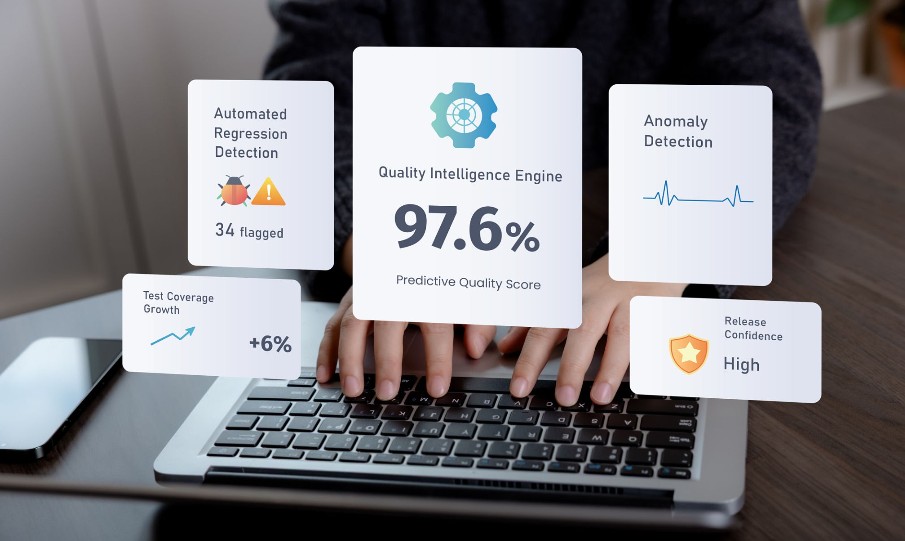
AI has fundamentally altered how testing frameworks maintain themselves. Traditional locators (like brittle CSS selectors or complex XPaths) that routinely broke after minor UI re-renderings are increasingly augmented by self-healing mechanisms. These algorithms monitor application changes and dynamically update element references during test execution. Furthermore, generative AI tools are routinely leveraged to produce edge-case matrices, synthetic test records, and regular expression patterns in seconds.
B. Shift-Left and Shift-Right Quality
Testing is no longer restricted to a discrete verification phase midway through a release cycle:
- Shift-Left: Quality engineers participate in early sprint planning and architecture sessions, conducting risk assessments and writing unit or component test criteria before developers write production code.
- Shift-Right: Quality extends into production environments through canary deployments, feature flags, synthetic user monitoring, and chaos engineering exercises.
C. Security and Non-Functional Verification
Security is no longer isolated in a separate cybersecurity department. Quality engineers are increasingly tasked with baseline security hygiene—checking for SQL injection vectors, validating Cross-Origin Resource Sharing (CORS) rules, inspecting header protections, and auditing third-party open-source dependencies for known vulnerabilities.
4. Actionable 60-Day Roadmap for Freshers
If you are a fresher looking to build credible proof of competency before applying for QA or SDET roles, follow this focused timeline:
- Days 1–15: Code & APIs: Solidify your JavaScript or Python fundamentals. Master HTTP protocols and write automated API assertions using
requestsorSuperTest. - Days 16–35: Modern UI Automation: Build a Playwright framework from scratch using TypeScript. Implement the Page Object Model (POM), configure multi-browser support, and incorporate automatic screenshot captures on failure.
- Days 36–45: CI/CD Pipeline Integration: Push your testing repository to GitHub. Configure a GitHub Actions workflow that executes your automated tests headless on every pull request and generates HTML test summary reports.
- Days 46–60: Project Deployment & Documentation: Add performance benchmarks with k6, link your live project on your resume, and write a detailed
README.mdarticulating your test strategy, design decisions, and CI setup.