
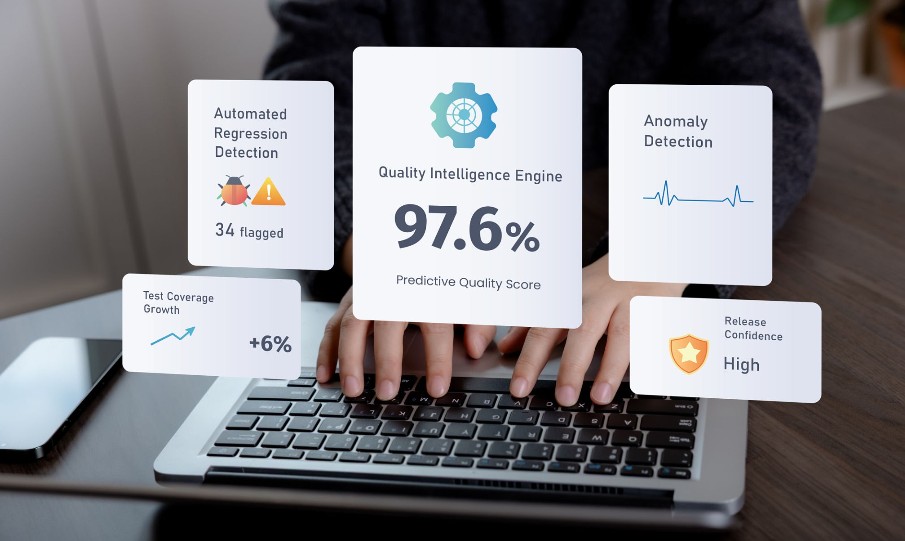
How AI Helps Quality Engineering: Moving from Reactive QA to Intelligent Verification
The Bottleneck in Modern Continuous Delivery
Software development has accelerated dramatically over the last decade. Continuous integration and continuous deployment (CI/CD) pipelines allow engineering teams to merge code dozens of times every day. However, standard testing workflows frequently struggle to keep pace with this release velocity.
Traditional Quality Assurance (QA) has long been held back by brittle automation suites. A minor tweak to a front-end CSS class or an updated DOM element frequently breaks automated Selenium or Cypress scripts, triggering false positives. QA teams often spend more hours debugging, rewriting, and babysitting flaky test suites than actually examining deep business logic or system edge cases.
This is where Quality Engineering (QE) powered by Artificial Intelligence is transforming the discipline. AI does not merely execute tests faster; it fundamentally reimagines how test suites are constructed, healed, and prioritized across the development lifecycle.
1. Self-Healing Test Automation
The single greatest operational drain on automated testing teams is test maintenance. In typical end-to-end testing, script locators rely on rigid selectors like specific XPaths, element IDs, or class hierarchies. When an application UI evolves, tests break—even if the underlying business transaction remains completely functional.
AI-driven testing engines resolve this issue through dynamic, self-healing algorithms:
- Multi-Attribute Object Recognition: Instead of relying on a single element identifier, AI engines analyze a constellation of attributes—including spatial position, accessibility tags, text labels, and parent-child hierarchies.
- Automatic Locator Remediation: If a button ID shifts from
#submit-btnto#checkout-confirm, machine learning models recognize the element’s intent and update the test locator in flight during test execution, logging the change without halting the deployment pipeline.
2. Autonomous Test Case and Synthetic Data Generation
Writing comprehensive test scenarios manually is time-consuming and often constrained by human cognitive bias. Engineers tend to test for expected paths, frequently missing obscure corner cases, input boundaries, or atypical user workflows.
Generative AI models and LLMs ingest user stories, API contracts (such as OpenAPI/Swagger schemas), and production logs to generate testing assets automatically:
- Edge-Case Scenarios: AI parses requirements and automatically generates matrixes covering malformed payloads, unicode inputs, boundary limits, and unexpected concurrency states.
- Privacy-Compliant Synthetic Test Data: Using generative adversarial networks and structured transformers, teams can generate realistic test databases that mirror production distributions without exposing real customer personally identifiable information (PII).
3. Predictive Quality and Smart Test Selection
In large-scale enterprise codebases, running an entire regression suite can take several hours, consuming heavy cloud compute resources and delaying urgent hotfixes. Running all tests for every tiny code modification is inefficient.
AI enables Test Impact Analysis (TIA). By mapping historical commit histories, code diffs, code churn patterns, and previous defect hotspots, predictive machine learning models determine the precise subset of tests required to validate a specific pull request. High-risk application layers receive exhaustive testing, while unchanged modules skip redundant suites, reducing pipeline cycle times by up to 70%.
4. Visual AI and Cross-Device Layout Inspection
Functional automation can verify that a button triggers a checkout event, but it struggles to detect whether that button is rendered invisibly beneath an overlapping banner, clipped on a specific mobile viewport, or displayed with corrupted font kerning.
Computer vision algorithms analyze visual layers much like a human eye would. They evaluate visual stability across hundreds of viewport dimensions, highlighting real perceptual defects while intelligently ignoring negligible rendering noise like pixel shifts caused by anti-aliasing.